
John Exter
One of my mentors . . .

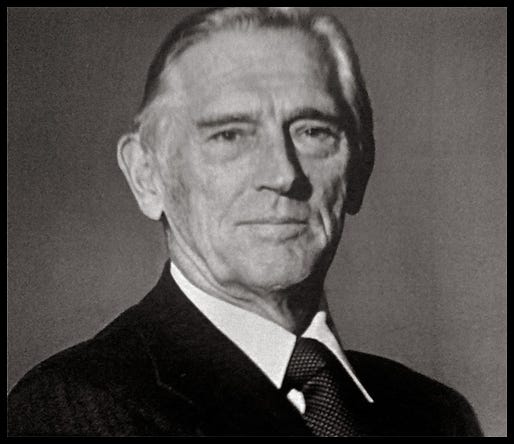
I don’t exactly remember the date when I met John Exter. But it was about 1970 and he was still a senior VP at City Bank advising international banks and such. He had just given a talk to the Mining and Prospectors of Oregon in Portland, Oregon, where he explained at length why the Savings and Loan industry was going to collapse and how important owning gold was for the preservation of purchasing power.
It was during the short break when I met him. It was in the men’s room! I immediately struck up a conversation and introduced myself as a rabid gold bug. The connection was to become very fortuitous. The next time we spoke was at a gold conference in Bermuda where a greater bond occurred.
I didn’t know at that time, but for the next ten years we would spend hours visiting on the phone or in person. I visited his home in New Jersey and he visited me and my team of gold nuts in Portland. Yes, his fee of a Krugerrand per day was no secret and I know he had stacks of them. At that time his portfolio of South African gold mines would put most gold funds to shame.
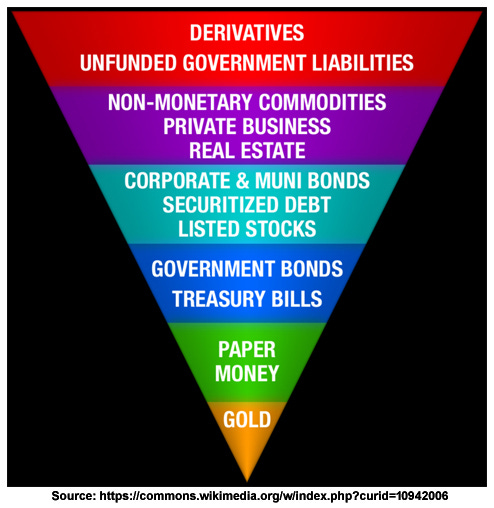
He drilled into me the importance of his gold pyramid for which he became famous.
Unbeknownst to most finance students today, John Exter was one of America’s greatest financial economists and he still has no peers. His message is as relevant today as it was then. He died on February 28, 2006 at 95 years old. For certain he would not believe the insanity that has gripped our nation’s leaders and financial professionals as they declare “this time it’s different.”
The only thing about Exter’s pyramid is that, when he drew it up, he didn’t envision a financial bubble of such extremes. Oddly enough, today six-month treasury bills and cash are the only non inflated assets left in our money and credit structure that’s not teetering on almost total collapse! That’s because, in time, all over-extended debts are settled by a horrendous deflation as the old system evaporates and everyone scrambles to acquire dollars to service debts.
Other than our tools and toys, people have not changed for hundreds of thousands of years. Our best financial universities are turning out students who may be great salesmen with their fancy knowledge of modern investing tools and “risk-free” derivatives. But they are as ignorant as sacks of hammers. They are not trained skeptics. They aren’t trained to be able to analyze risk versus reward. They’ve heard of balance sheets, earnings, debt ratios, and such, but don’t know how to use them properly. They don’t have historical perspectives on anything they are doing! What they do know is how to go with the flow. In other words they are totally unprepared for the “Battle for Investment Survival.”
If you aren’t familiar with that book, you’re a babe in the woods—literally a sheep to be sheered. Today’s investors are by and large totally clueless. They know absolutely nothing about the wisdom of the greatest investors of our times. But they’ll learn. Buy and hold is simple, but far from guaranteed other than to line the pockets of brokers and advisors.
Check out the links. They expand on these topics for real down-to-earth perspectives. Then you will understand that, when it comes to investing, it’s every man for himself. People are people and the investing game is a brutal take-no-prisoners war.
John Exter from Wikipedia, the free encyclopedia
This Time is Different’: The Most Dangerous Investing Myth from Investurns.com
Battle for Investment Survival (Wiley Investment Classics) 1st Edition by Gerald M. Loeb